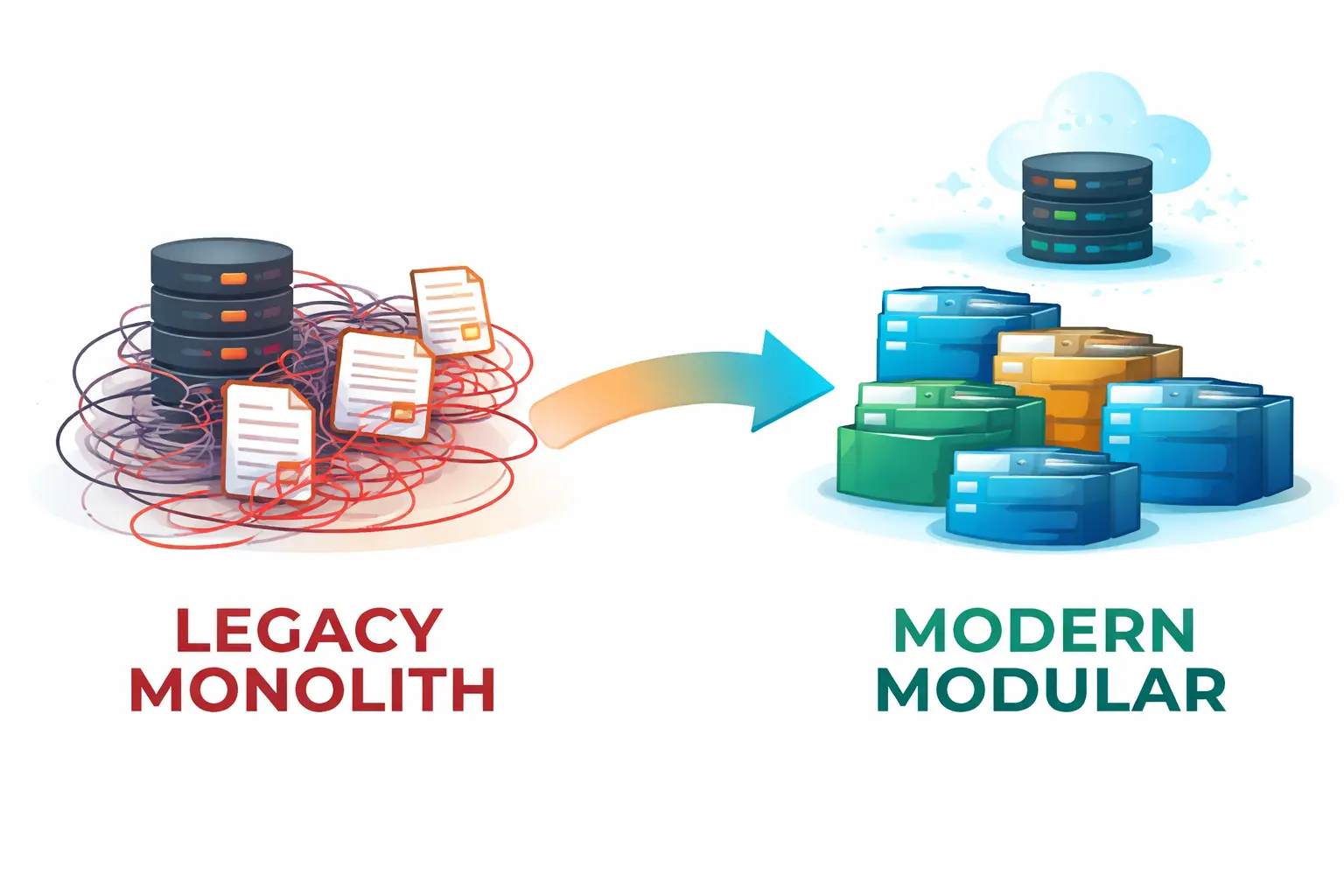
The Architectural Evolution: A Structural Deep Dive
To understand how I build systems today, we have to look at the structure. Below is the “Tree” view of my transition from a traditional MERN Monolith to a modern, Edge-Native Modular system.
1. The Legacy Architecture (BazarBhai)
This follows the classic Layered Monolith pattern. Logic is separated by technical function (all models together, all routes together).
bazarbhai-backend/ (The Monolith)
├── src/
│   ├── config/             # Environment-specific settings
│   ├── models/             # Data definitions (MongoDB schemas)
│   │   ├── userModel.js
│   │   └── productModel.js
│   ├── routes/             # API Endpoints
│   │   ├── userRoutes.js
│   │   └── productRoutes.js
│   ├── middleware/         # Security & Auth (Global)
│   │   └── checkAuth.js
│   └── helper/             # Business Logic (Scattered)
│       ├── order/          # Logic detached from the API layer
│       └── products/
└── server.js               # Central point of failure
The Flaw: As this grows, it becomes “Spaghetti Code.” If you change a field in userModel.js, you have to manually search every file in helper/ and routes/ to make sure it doesn’t break. There is no automatic safety.
2. The Modern Architecture (TrackFlow)
This follows the Modular Edge-Native pattern. Logic is separated by feature (everything about ‘Events’ is in one folder).
trackflow-backend/ (The Modular Edge)
├── src/
│   ├── app/                # Application "Bootstrap"
│   │   ├── register-routes.ts
│   │   └── create-app.ts
│   ├── db/                 # The "Source of Truth"
│   │   └── schema/         # Drizzle Schemas (SQL)
│   │       ├── user.ts
│   │       └── event.ts
│   ├── modules/            # Domain-Driven Modules
│   │   ├── event/          # Fully self-contained feature
│   │   │   ├── event.routes.ts     # Definition
│   │   │   ├── event.schema.ts     # Validation (Zod)
│   │   │   ├── event.controller.ts # Orchestration
│   │   │   └── event.service.ts    # Business Logic
│   │   └── site/
│   ├── queue.ts            # Background Worker (Edge-Native)
│   └── index.ts            # Global Edge Entry Point
├── wrangler.jsonc          # Cloudflare Infrastructure Config
└── drizzle.config.ts       # Database Migration Config
The Strength: This is Type-Safe.
- If I change the
event.tsdatabase schema, TypeScript immediately shows me errors inevent.service.ts. - OpenAPI Integration: The structure in
modules/allows me to auto-generate documentation.
Comparison: Why I Switched
| Feature | BazarBhai (Old) | TrackFlow (New) |
|---|---|---|
| Logic Placement | Scattered across helper/ and routes/ |
Encapsulated in modules/[feature]/ |
| Data Validation | Manual checks inside functions | Automatic via Zod-OpenAPI |
| Deployment | Single Server (Limited) | Edge Network (Global/Cloudflare) |
| DB Handling | Non-relational (Risky data drift) | Relational SQL (Drizzle ORM) |
Summary of my Design Goal
I design for predictability. By using a modular tree structure like the one in TrackFlow, I ensure that a client’s system is easy to upgrade, impossible to “break” by accident, and runs with zero latency on the edge.