
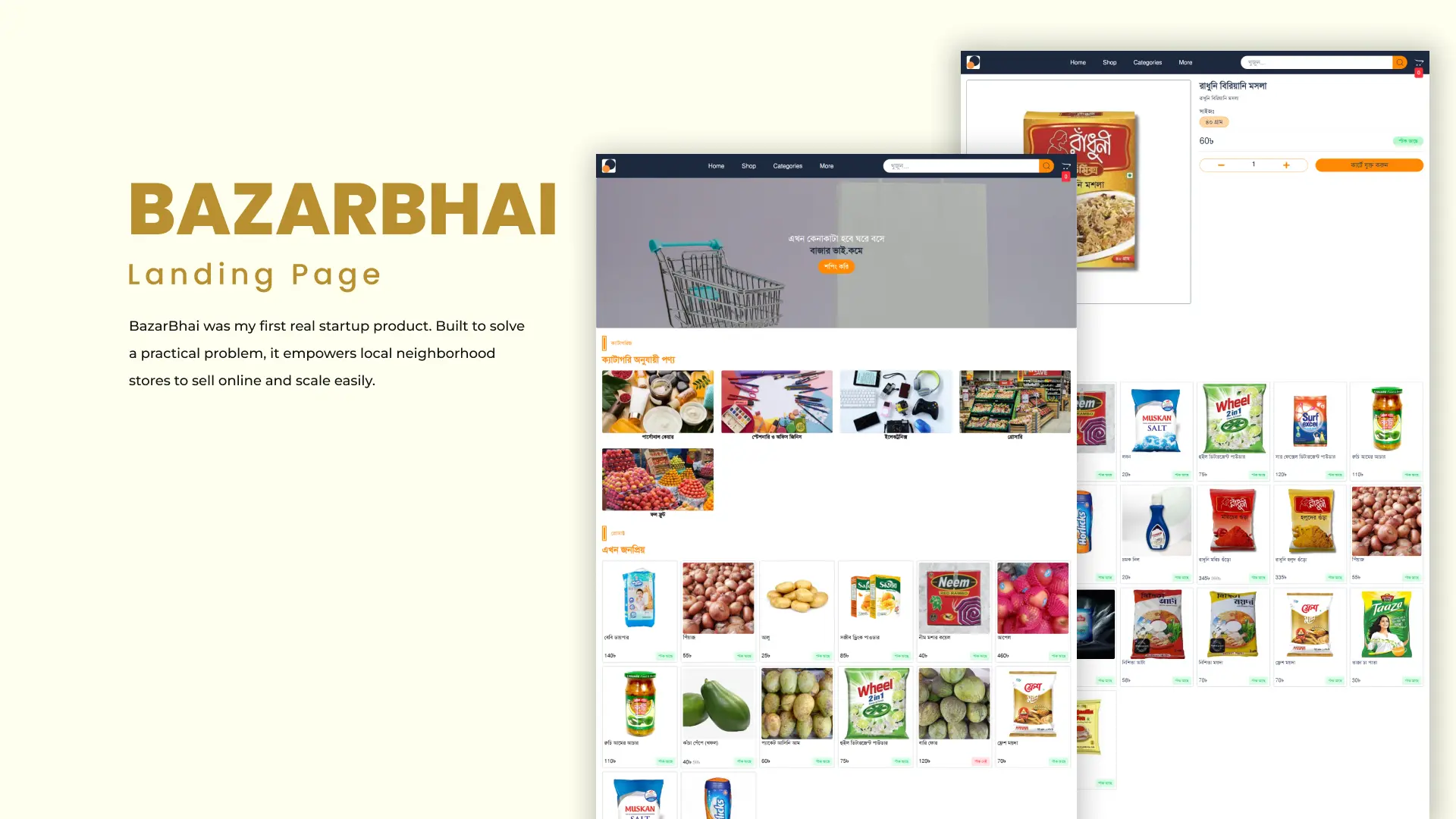
⚠️ Hosting Notice: These live demos run on a free, sleeping server to reduce infrastructure costs. The first request may take 30–60 seconds to wake up.
Live Ecosystem & Source Code
| Platform | Role | Live Demo | Source Code |
|---|---|---|---|
| Customer Store | Shopping App | Visit Site | GitLab |
| Backend API | Core Server | System Only | GitLab |
| Seller Portal | Vendor Dashboard | Access Restricted | GitLab |
| Control Center | Admin Dashboard | Access Restricted | GitLab |
🔒 Data Privacy & Access Note: To show complete technical transparency, the complete source code for all four platforms—including the Admin and Seller panels—is entirely open-source and public on GitLab. However, live staging environments and access routes for the Admin and Seller dashboards are strictly private. Because these internal systems handle real-world local merchant records and private transactional histories, access is restricted to safeguard user data integrity.
1. The Problem
Small neighborhood brick-and-mortar stores are heavily dependent on physical foot traffic. They lack the technical tools to compete with e-commerce giants. To bridge this gap, I needed an ecosystem that could simultaneously handle customers, independent vendors, and system administrators without data conflicts.
2. The Solution
I built BazarBhai, a multi-vendor marketplace ecosystem split into three specialized applications sharing a single backend:
- Customer Storefront: A clean interface for browsing local shops, cart management, and order tracking.
- Vendor Dashboard: An isolated portal for local merchants to manage their specific inventory and track sales.
- Admin Control Center: A centralized panel for platform moderation, vendor onboarding, and system metrics.
3. The Tech Stack
I chose a flexible, traditional JavaScript stack to move quickly, iterate fast, and validate the marketplace concept.
- Frontend: React, Vite, JavaScript (ES6)
- Backend: Node.js, Express API (REST Architecture)
- Database: MongoDB, Mongoose ODM (For handling dynamic, varied vendor products)
3. Post-Mortem: Why It Failed & Lessons Learned
Building BazarBhai taught me that a successful engineering rollout is only half the battle. I ultimately chose to freeze production due to two primary bottlenecks:
- The Solo Founder Trap: As a solo engineer, managing the full-stack development, continuous deployment pipelines, and UI design was sustainable. However, simultaneously handling localized merchant onboarding, physical marketing, and ground operations became an impossible logistical hurdle without a dedicated business team.
- The Plain JavaScript Bottleneck: As the multi-dashboard ecosystem expanded, managing state variations and data flows across three separate platforms in plain JavaScript became highly error-prone. Debugging complex runtime anomalies consumed valuable development hours that could have been saved with strict type safety.
🚀 The Architectural Pivot
This failure was the ultimate catalyst for my growth. It forced me to abandon bloated monolithic setups and shift entirely to modern, high-leverage paradigms.
Today, I build exclusively with TypeScript, Hono, and Cloudflare Edge tooling—ensuring absolute type safety, zero-cold-start execution, and a minimalist design footprint that maximizes operational efficiency.